Monday, July 4, 2011

A Theater In Absurdity.


Anyone who made money in the last weeks rump job in US Stock Markets, were more lucky than smart.

There never is or was any reason for the stocks to join the 100 meter sprint apart from the urge for bonus of the Banksters and very necessary window dressing for EOM and EOQ. Listen to the following interview from ECRI head Lakshman Achuthan. ECRI is saying that all leading indicators are decisively turning  down.


Talking heads of the News media are saying that the markets went up because the Greece issue was resolved. Really? Which way?

I get the feeling the Greeks have got the Europe by you know what. They are milking Europe dry so that the Greeks can continue to spend money which they don’t have and retire when they are 53. Imagine a German worker working till s/he is well past 60 and pay money for the Greek bailout, so that the unionized Greek worker can enjoy life shortly after puberty.

The Greek drama is a theater in absurdity. Greeks know that they will default. Other Europeans know that they will default, And everyone is trying for the best seat in the theater , Greeks to get the best deal and some more money, Other EU Nations to prepare their Banks for the aftershock.

I read an interesting article in BBC recently. The Greek demonstrators will throw stones at riot police in their parliament square, Police will throw tear gas to demonstrators and after some time when they are tired, they (both the demonstrators and police) would go to some side lane cafes and have a well earned coffee break.  Sitting next to each other, laughing and chatting about life.  And the Greek politicians will tell the EU, you can see the social tension, so cut us some slack. How long before other European nations find out that they are hostages  of the Greeks. Just like the Americans are the hostages of Pakistan.  US know that Pakistan is the epicenter of terrorism, and yet they are force to give billions of dollars to Pakistan to fight terror. It would seem that the biggest export item and revenue earner of Pakistan is state sponsored terrorism and the biggest export item and revenue earner of Greece is the threat of contagion.   


Otherwise how on earth Greece has not sold one single state enterprise in the last 18 months to reduce the budget deficit. And talking about budget deficit, Greece has already missed its June budget target, even before they get a dime out of the 12 billion promised by EU. It is one lie after another and difficult to understand which moron is lying more. What is not difficult to understand that things are not going to end well.

Some Loud Thinking On 4th. Of July.


Price action defines news and not the other way around. All the talking heads in the 24 hour television have to say something to fill the time and hence they spin the news good or bad based on the price action in the market. If one has to take an investment decision based on these talking heads, one is doomed forever.

In this constant noise we almost always lose the music. And the music is the continuous sound of the wave on the shore of civilization. Events like the waves come rushing in, make noise and brake up. Then they recede and a new wave / event start. In a way, the history of civilization is very similar. For thousands of years there have been dynasties, kings, civilizations which have ruled supreme in their time. In their time, they have considered themselves as indestructible and forever.  How is the present time any different?

Every civilization flourishes when the income of the state exceeds its expenditure. In a way it is very similar to the household. Then comes a time when the expenditure exceeds what the state can support and the rulers try to find some new methods to carry on. In the time of Roman Empire, the Romans started with debasement of their currency and it reached a point when their currency was useless. Today we see the same drama being played all over the world.

The main culprits in this end game are the Central Bankers of the world with the exception of Germany and Holland in Europe and Singapore in Asia. Fed in USA is not the only one who has created the monster deficit. Japan is the dead man walking with debt over 200% of its GDP. We all know the situation in Greece, Ireland, Portugal, Spain and Italy.  With Trillions of dollars of debt and many times more unfunded liability which are off the book, balance sheet, there is no way this situation can ever be corrected. There comes a time when the debt explodes like a supernova and all the excess is purged of the system. It is time of extreme pain for those countries. The 1st sufferers are the bottom 90% of the population who has to struggle to make ends meet and at some point the social unrest sweeps over the ruling elite. We see it happening before our eyes as it happened in Tunisia, Egypt and other Arab countries and yet we think it will not touch us. We see the Greeks hurling Molotov cocktails and we wonder how long before the 40% unemployed youths in Spain will do the same.

With food stamp at record high in USA and social benefits soaring in other countries, the ruling class is engaged in providing “Bread and Circus” to its population. Two trillions of dollars of Fed intervention has done nothing to solve the structural problem and the next storm will be worse than that of 2008. Watch this YouTube video of David Stockman :  http://www.youtube.com/watch?v=GHLjoAI2-iQ  and make your own judgment.

The growth in GDP if any is completely fueled by borrowing. It has reached a point when more debt is not resulting in any increase of GDP. Is this the beginning of a bear market? I am not sure. What I am sure is that we are reaching the end of the debt super cycle. It is going to be a time of tremendous pain as well as opportunities.

I am not trying to be pessimistic. Nor I am a perm bear.  In Hindu religion, there is Lord Shiva, the “ God of Destruction.”  Those people realized and accepted the need for destruction.  When things decay, they need to be destroyed so that new life comes out of the ash. That is law of nature. If we preserve the decay by “extend and pretend”, we only delay the inevitable and increase the pain.

I am very hopeful for the future because the future of our children cannot be bad. Amidst all the greedy and self serving Banksters and Politicians, there will come some courageous people who will change the course of history. I remain the eternal optimist. 

Natural chaos in the markets

I'm giving a short talk in a couple weeks at a meeting of a Leverhulme Trust project on tipping points in physical and social systems. The organizers just asked me to send a rough outline of what I'm going to talk about -- under the working title of Financial Instabilities -- so I thought it might be useful to do that in a blog post, which might also give some useful background and motivation for everything in this blog (i.e. how ideas from physics can help us understanding financial systems). So here goes.

I used to work in plasma physics. A plasma is just a gas -- say, simple hydrogen gas -- which has been heated up to the point where the atoms come apart. At high enough temperature, the energy binding an electron to the nucleus (a single proton in this case) to form an atom is overwhelmed by the kinetic energy in collisions. The result is a hot gas of charged electrons and nuclei (protons), in which the particles, being charged, now interact over extended distances, unlike in normal gases where particles only interact when they undergo direct collisions.

These longer range interactions make plasmas behave very differently from ordinary gases, whether the plasma is in the Sun or the Earth's upper atmosphere, in a nuclear reactor, the interstellar medium, or in a particle beam racing around an accelerator. The basic properties of a plasma in equilibrium -- say, held at a fixed temperature in a glass tube -- were worked out (at least approximately) long ago, although the physics is still so rich that many subtle mysteries remain.

As soon as you do anything interesting with a plasma, taking it a little out of equilibrium, things get infinitely more complicated. Natural plasmas not held in fixed and unchanging conditions do all kinds of surprising things -- mostly involving natural instabilities driven by positive feed backs.

I think this example of what happens in a very simple system should give us some hints about how we should go about studying far more complicated things like markets and economies.

A good example of plasma surprises comes from the ongoing project to harness energy from nuclear fusion. The recipe for success seems simple: heat up some hydrogen gas to enormous temperatures and you create conditions in which colliding hydrogen nuclei will fuse together to form heavier nuclei. As an aside, you can't use ordinary hydrogen, but have it's isotopes, deuterium or tritium, the nuclei of which contain a proton and either one or two neutrons. These things can fuse together into unstable nuclei, which decay, ultimately creating nuclei of the stable element helium, with two neutrons and two protons. Lots of energy is given off in the process, so the reaction can be self-sustaining.

Lots of fusion requires nothing but high temperature (so the collisions are very energetic) and high density (so there are lots of collisions). So you put a mixture of deuterium and tritium into a container, heat it up and compress it, and there you go -- cheap, virtually inexhaustible energy. The only problem -- and it's a very big problem -- is making the damned plasma behave itself as you try to do this.

One of the principal routes for pursuing fusion energy is so-called Inertial Confinement Fusion (ICF). The idea is to take a tiny pellet which has a mixture of deuterium and tritium in it, and blast it from all sides with extremely high intensity x-rays. This violent bath vaporizes the pellet surface, producing plasma that explodes outward, compressing the rest of the pellet inward and creating extreme densities and temperatures. Through further mechanisms -- colliding shock waves and such -- you hope to get a fair number of nuclei colliding with sufficient energy to undergo fusion, giving off still more energy.

But it doesn't work, at least not yet, because of plasma misbehavior. The figure below illustrates the typical problem -- as the dense hot plasma rushes inwards, the spherical symmetry inevitably gets spoiled by growing ripples. These are caused mostly by the so-called Rayleigh-Taylor instability that happens whenever a lighter fluid pushes on a heavier fluid. As the waves get bigger, this first instability causes secondary instabilities of other kinds. In the figure below, the initially nice symmetry gets hopelessly ruined and different parts of the compressing system get mixed together, which undermines the process that would have given high temperature and density. Interestingly, what happens in inertial confinement fusion during implosion (left image) is very close to what happens during a supernovae explosion (right image).
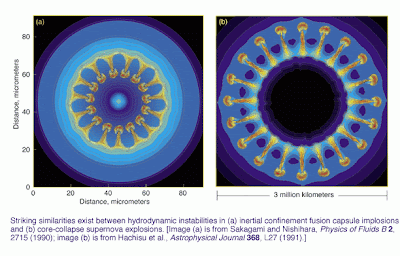


The second figure below shows how one wave growing from the Rayleigh-Taylor instability soon creates a cascade of other instabilities, and the situation becomes infinitely complex very quickly through the interaction of several instabilities.


Remember, this all comes out of nothing but a system of electrons and positive nuclei compressed and heated in a spherically symmetric situation. The system in fact is remarkably simple. But natural instabilities -- mechanisms that make small differences and imbalances grow into much larger ones -- make it's behaviour anything but simple. Fifty years of intense research and engineering on inertial confinement fusion still hasn't managed to tame these problems. The plasma always finds another way to do something surprising that no one predicted.

Because of these instabilities, there's not a lot that is simple in plasma physics. Systems that are conceptually simple -- a beam of one single kind of particle flying around a circular ring in an accelerator -- can go unstable in hundreds of ways. There used to be a book (now out of print, I think) called the Handbook of Plasma Instabilities, which tried to list and describe all the stereotypical ways that a plasma in different simple situations will do something surprising and unexpected because of positive feed backs. It was about 800 pages long. Every entry testified to some situation in the past in which physicists or engineers had tried to do something with a plasma, only to find that it refused to go along -- its stable behaviour giving way, often explosively, to some wobbling or mixing or unexpected heating and so on.

The names of these instabilities refer crudely to what happened, why it happened or who first explained what happened. The list (wikipedia gives a brief one here) starts with the Beam acoustic instability, Bump-in-tail instability, Buneman instability, Cerenkov instability, Chute instability, Coalescence instability, Collapse instability, Counter-streaming instability, etc, continues through the Fan instability, Filamentation instability and Firehose instability leads up to the Oscillating two stream instability, Pair instability, Parker instability and Peratt instability, and finishes with the Two-stream instability, Weak beam instability, Weibel instability and Z-pinch instability. That's just a sample.

All the instabilities mentioned above illustrate how a really simple thing -- some charged particles held in a bottle -- has an extraordinarily rich set of dynamics because of natural non-linearities and interactions and the positive feed backs to which they lead. In the case of plasma, we know the laws of behaviour for the individual particles with perfect accuracy (Newtonian mechanics with corrections from quantum mechanics when necessary). Even so, these systems still surprise as as much as they do what we expect.

Now, let's think about finance and economics. Here we're dealing in general with systems made of people driven by thoughts and emotions and interactions with other people. We surely don't know with perfection the laws of behavior of these people -- we have a few crude rules offering guidance to how they sometimes behave or might behave. Humans being among the most complex things in the universe, we should surely expect these systems to present a much richer set of possibilities than a simple plasma. Indeed, we know that markets and other economic systems, historically, have routinely acted in surprising ways and caused crises of many different kinds. Even so, theories in economics and finance have until very recently been centered almost entirely on the study of equilibrium systems, with positive feed backs rarely being considered.
 
This shortcoming is one of the principal motivations for lots of recent work by physicists and others aimed at modeling and understanding natural instabilities in economic systems. The list of instabilities likely to be found will probably be a lot longer than the list in plasma physics. In my talk in Durham, I'm going to take a stab at making a similar (crude and very incomplete) list of some economic and financial instabilities. As in plasma physics, we should find instabilities acting on many timescales -- from milliseconds up to years. We should find some that act through fairly mechanical processes (laws which compel certain behaviours), and others working on the basis of natural human psychological and decision making tendencies (learning, speculation and so forth). We'll find some that take off through the actions of only a few parties (hedge funds, for example, during the "Quant Meltdown" of August 2007) and others driven by large-scale network effects.

I haven't finalized my talk yet,  but I intend to describe very briefly some recent work on a number of these kinds of instabilities (perhaps they should be called classes of instabilities, as many distinct situations may fall into classes of quite similar behaviour). My initial list:

1. Expectations instabilities -- these include market rallies or crashes driven by the interaction of chartists versus fundamentalist investors, or more general models of markets or economies in which people have heterogenous expectations. A fascinating example (of which there are quite a few) is this paper by Brock and Hommes from 1997 in which almost rational individuals acting adaptively in a simple market lead to natural instabilities and a true strange attractor (dynamical chaos) in the market.

2. Leveraged/correlated strategies instabilities -- the sub-prime fiasco is probably a good example of this, as so many banks were heavily leveraged and invested in CDOs and other assets ultimately backed by the mortgage market. But a more specific and perhaps simpler example to analyse is the Quant Meltdown of August 2007, during which a number of hedge funds went bust in two explosive episodes lasting only a few hours. I'll describe a simple and beautiful model (in this paper by Farmer, Geanakoplos and Thurner) suggesting a natural instability which puts a market in a metastable state in which explosive collapse is certain in the long run, yet hard to predict in its timing as the end is triggered by a random spark.

3. Hedging instabilities -- several recent papers (here and here, for example) document how adding more hedging instruments to a market, which traditional theories suggest should make markets more complete and effficient, actually makes them more unstable.

4. Trend following/relative strategy instabilities -- in a recent post I reviewed ongoing events in markets driven by high-frequency trading which suggest the action of some very unstable natural dynamics. These dynamics, still unknown in detail as yet, were probably behind the Flash Crash of 6 May, 2010, as well as a number of more recent similar events in which single stocks have plummeted to a few pennies in a matter of minutes before recovering. One of the most interesting analyses I've seen is this one by computer scientist Michael Kearns and colleagues, who analysed data from HFTs and found the signature of dynamical chaos (positive Lyapunoc exponents) in the dynamics of the order book (the book in which actors place market orders or limit orders to facilitate trades). The trouble seems to be caused by algorithms which use "relative strategies" -- taking action not on the basis of some fundamental view of prices, but reacting to recent price movements.

5. Diversification instabilities -- I'll also explore briefly the conclusions of this provocative paper which shows how an increasing density of risk sharing between banks in a network, naively believed to decrease overall systemic risk, can actually increase risk to the entire system. A network can become dangerously over-dense.

I'll also make a few stray comments on some other instabilities too -- the "loss of trust" instability, the "gaming" instability, the "looting" instability and the "this time is different" instability.

But my point overall isn't to argue that this list is anything but arbitrary. The more important point is to argue that making a list of this sort, and understanding the spectrum of natural market instabilities, ought to be a main focus of the science of finance and economics. The long-standing fixation on equilibrium analyses in economics effectively rule out of existence precisely the events and processes of greatest interest.

Sunday, July 3, 2011

So, What Changed?


Last week the Us Stock Markets were on a tear, gaining almost 5% for the week. All the bears were wiped out and there is now talk of a new bull run.

But I am scratching my head to figure out the reason for such exuberance.

OK, Greece is fixed for a while, but we shall visit there again, I promise.  The European Banks have just purchased little bit of time. By itself, Europe is not worried that Greece will go bankrupt; because they know that it will happen soon. They are worried of the contagion effect with Portugal, Ireland and Spain.  And Italy is not looking too good either.

Has the  US Economy become strong over one week? Is the better than expected PMI caused the stock markets to get up and run? Unlikely, because most of the gain in the PMI was from inventory restocking which is bad for the future. The US Economy is going along at a stall speed of 2% growth in GDP and with the biggest debtor nation on earth not showing much life, how long before a QE3 will be needed is anyone’s question.

So what gives? Apart from end of the month and end of the quarter manipulations, I have no answer.
Have we reached the bottom of the correction that started in June? I doubt it. May be it is a good shorting opportunity, because going long based on hope and manipulation is not a good idea. We shall know very soon.

Wednesday, June 29, 2011

Why we GIVE each big bank $12 billion per year

I've been reading quite a lot about the various political battles over efforts to regulate the banking industry, derivatives in particular. This afternoon, quite by coincidence, I noticed on a colleagues' disordered desk a copy of a speech given last year by Andrew Haldane, Executive Director for Financial Stability of the Bank of England. It's message should be a matter of urgent public debate in the US, and elsewhere. Yet I haven't heard Haldane's arguments mentioned anywhere in the US media.

Banks, he argues, are polluters, and they need to be controlled as such. Let me run through several points in a little more detail. First think of the car industry, where producers and users together pollute. Haldane:
"Exhaust fumes are a noxious by-product. Motoring benefits those producing and consuming car travel services – the private benefits of motoring. But it also endangers innocent bystanders within the wider community – the social costs of exhaust pollution."
He then goes on to make the point that we now face much the same situation with bankers, in part due to the proliferation of instruments which have made it possible for banks to spread risks far and wide and make profits events as they amplify system wide risks. The banking industry is also a polluter:
"Systemic risk is a noxious by-product. Banking benefits those producing and consuming financial services – the private benefits for bank employees, depositors, borrowers and investors. But it also risks endangering innocent bystanders within the wider economy – the social costs to the general public from banking crises."
What is to be done about polluters? Back in the 1970s, in the face of the rising air pollution, policy makers, guided by economists, worked out ways to solve the problem through regulations and, where necessary, outright prohibitions of some practices. That's where we are now with the banks. The regulations under consideration recognize the social costs of systemic risk and try sensibly to find a redress. The bankers response has of course been to whine and scream.

The first practical step in addressing a pollution problem is to estimate how much pollution there is. How much do we pay to guarantee bank solvency during these not-too-infrequent systemic crises? Haldane points out that if you count only the monetary amount transferred to banks by governments, the cost of the recent crisis is fairly large -- about $100 billion in the US. But this is probably an extreme lower bound to the true collective cost. As Haldane remarks,
"...these direct fiscal costs are almost certainly an underestimate of the damage to the wider economy which has resulted from the crisis – the true social costs of crisis. World output in 2009 is expected to have been around 6.5% lower than its counterfactual path in the absence of crisis. In the UK, the equivalent output loss is around 10%. In money terms, that translates into output losses of $4 trillion [for the US] and £140 billion [for the UK] respectively."
Now, I'm not one to take GDP loss arguments too seriously. It's not a very good measure of human well being, or even of the narrow economic well being of a nation (in particular, it tells us nothing at all about how much of the store of natural resources may have been eaten up in achieving that GDP). However, the scale alone in this case suggests that the cost of the crisis -- and other crises, which seem to strike more and more frequently with modern financial engineering and its global reach -- are immensely high.

But here is where Haldane's view becomes REALLY interesting -- and goes beyond anything you're likely to see in the popular media (especially in the US).

Lots of people recklessly borrowed in the run up to the crisis; it wasn't only the fault of the recklessly loaning banks. So, how much of the systemic costs associated with financial crises really is due to the banks? One place to look, Haldane suggests, is the valuations given to banks by the ratings agencies, many of which take explicit note of the fact that governments give a subsidy to banks in the form of implicit or explicit safegaurds to their stability. Some give banks two different ratings, one "with government support" and one "without." Haldane goes through a simple calculation based on these ratings, and estimates the effective subsidy to many big banks is on the scale of billions. The data suggests it has been increasing for the past 50 years. The "too big to fail" problem shows up in the data as well -- the average ratings difference for large banks is much bigger than it is for small banks. As Haldane sums up:
For the sample of global banks, the average annual subsidy for the top five banks was just less than $60 billion per year...  the large banks account for over 90% of the total implied subsidy. On these metrics, the too-big-to-fail problem results in a real and on-going cost to the taxpayer and a real and on-going windfall for the banks."
Haldane's speech -- as far as I'm aware -- is unique among high-level banking figures in taking seriously the public costs entailed by banking practices. Imagine where the US might be today if we'd taken that $60 billion per year and, over the past decade, invested it in infastructure, education and scientific research.

In the rest of his speech, Haldane explores what might be done to end or control this pollution, through taxes or by making some banking practices illegal. This too is illuminating, although what emerges is the view that finding a solution itself isn't so hard. What is hard is gathering the political will to take steps in the face of banking opposition. Publicizing how much they pollute, and how much we pay to let them do it, is perhaps a first step.

Monday, June 27, 2011

Analysis of the stock market rally of 28th June.

Today the markets rallied and closed solidly in green. However I have few concern regarding the coming uptrend so eagerly awaited by the bullish small speculators.


  • The VXO is in 20s. All past major corrections have ended with VXO in the range of 28+.
  • If  we look at the weekly chart of SPX and put a 75 simple moving average, we shall see that from 2004, all corrections have ended near or below 75 SMA on a weekly chart. By that reckoning, we still have a fair way to go.
  • The money flow was very negative.The Block Traders sold in the strength in the last hour. If past is any indicator, normally the next day is a huge gap down day.
  • The CBOE market data shows that the retail investors have turned bullish.
So I am not holding my breath for a stock rally yet.

I think what I think.


A new week. But the old Greek drama continues. The market has been selling off for eight weeks now. So where do we stand. I am thinking that:
      ·         Although S&P 500 has sold off 7.5% from the June 1st, the fear factor is not high enough to call a bottom. In that logic, I am thinking that we shall see continuation of the sales.
  •        It is possible that we shall see a breach of the 200DMA and then the panic factor comes in play. 
  •    It is possible that by Wednesday, 29th June 2011, we shall see a huge sell off coinciding with the Greek vote. 
  • Because of the uncertainty regarding the Greece situation, the Euro has been selling off. Along with Euro other risk assets like Gold , Silver, Oil etc are also soft.
  • All these commodities along with the stock markets will possibly reach bottom by Wednesday when the market will realize that the Greek vote is inconsequential.
  • We would possibly see a summer rally, in opposite thinking of end of Fed induced liquidity, when retail investors might think of leaving the market.

So I am thinking and  I am marking Wednesday, 29th June as the date of reckoning.

But if the VXO does not reach high 20s by then, I would still think that the sell is not over yet. In short term stock markets are ruled by greed and fear. As of now, there is very little fear. the retail investors have turned bullish as evident from the put/call ratio.Unless we see fear and panic, there is no point going long. So if 29th June gets pushed to 5th July, so be it. I would rather wait.