Paul Samuelson (the first American Nobel Laureate in Economics, and arguably the most influential economist of the 20th century) died today at home at age 94. He was largely responsible for the transformation of economics from a largely descriptive and discursive discipline to a highly mathematical and rigorous one.
He was responsible for turning MIT into a world-class economics center - over the years, he played a role in bringing in Solow, Engle, Klein, Krugman, Modigliani, Merton, and Stiglitz.
In addition, he wrote perhaps the single most popular and widely used economics text in history - "Economics", published in 1948. I read it in my undergraduate years in the late 1970s, and it was still selling 50,000 copies a year in the late 1980s.
A giant has passed.
Showing posts with label Economics. Show all posts
Showing posts with label Economics. Show all posts
Sunday, December 13, 2009
Saturday, June 27, 2009
Even Children Can Understand Economics
Every once in a while (actually, make that "on a regular basis), the Unknown Daughter comes out with something that really floors me.
The other day, UD was asking about my grandparents. I told her that both grandfathers worked it the fabric mills in my hometown (back in the day, there were three mills in town). Somehow, the topic morphed into what happened to the mills, so I told her that the mills eventually moved a lot of their business down south, and then (eventually) overseas.
"Why?" she asked?
I answered, "Because the people there would work in the factories for less, so the mill owners could make the fabric more cheaply. Unfortunately, that means that a lot of the workers in the mill lost their jobs."
"So why did they do it if the workers lost their jobs?"
"Well UD, since it cost less to make, they could sell the fabric at a lower price. So, while the workers lost jobs, the people who bought it actually benefited. This means that some workers lost money, and the people who bought the fabric benefited."
Here's what she said: "But Daddy - the people who bought the fabric weren't the only ones who got something out of it. The people who sold the fabric and the people who owned the stores made more money, so they could spend more on other things, like movies and meals and stuff, so they helped the people who sold those things. And then those people had more money, so they could hire more workers, so they benefited, too."
I asked her how she came up with this idea, and she said she just did. Then she gave me "that look" (i.e. 8 years old going on teenager), and said, "After all--my dad IS a finance professor, so I should be smart".
After thinking about it, I realized that she'd gotten that right, too. But the "genetic" story wasn't what I was thinking about--she picked this up largely through osmosis, since I'm often trying to get the Unknown Wife to think in economic terms (i.e. who benefits and who loses, and how). Of course, when I do this, it only serves to tick UW off.
But UD misses little, and remembers most things she hears or sees. So, when she turns teenager, I'm in biiiig trouble.
I shared this with one of my colleagues, and he suggested that I should have UD talk with our state legislators - she could teach them a thing or two.
But given this Wall Street Journal article, I'm skeptical.
The other day, UD was asking about my grandparents. I told her that both grandfathers worked it the fabric mills in my hometown (back in the day, there were three mills in town). Somehow, the topic morphed into what happened to the mills, so I told her that the mills eventually moved a lot of their business down south, and then (eventually) overseas.
"Why?" she asked?
I answered, "Because the people there would work in the factories for less, so the mill owners could make the fabric more cheaply. Unfortunately, that means that a lot of the workers in the mill lost their jobs."
"So why did they do it if the workers lost their jobs?"
"Well UD, since it cost less to make, they could sell the fabric at a lower price. So, while the workers lost jobs, the people who bought it actually benefited. This means that some workers lost money, and the people who bought the fabric benefited."
Here's what she said: "But Daddy - the people who bought the fabric weren't the only ones who got something out of it. The people who sold the fabric and the people who owned the stores made more money, so they could spend more on other things, like movies and meals and stuff, so they helped the people who sold those things. And then those people had more money, so they could hire more workers, so they benefited, too."
I asked her how she came up with this idea, and she said she just did. Then she gave me "that look" (i.e. 8 years old going on teenager), and said, "After all--my dad IS a finance professor, so I should be smart".
After thinking about it, I realized that she'd gotten that right, too. But the "genetic" story wasn't what I was thinking about--she picked this up largely through osmosis, since I'm often trying to get the Unknown Wife to think in economic terms (i.e. who benefits and who loses, and how). Of course, when I do this, it only serves to tick UW off.
But UD misses little, and remembers most things she hears or sees. So, when she turns teenager, I'm in biiiig trouble.
I shared this with one of my colleagues, and he suggested that I should have UD talk with our state legislators - she could teach them a thing or two.
But given this Wall Street Journal article, I'm skeptical.

Monday, May 25, 2009
Googlenomics, Auction Theory, and Hal Varian
Like many programs, the Unknown Alma Mater's doctoral program used Varian's Economics text for our Micro Sequence. So, I perk up when I hear Varian's name mentioned.
It turns out he's Google's Chief Economist (who knew - Google has a chief economist?). A recent Steven Levy piece in Wired magazine talks about the ways the company uses economic theory (and auction theory in specific) in their Google AdWords program. Here are a couple of snippets:
It turns out he's Google's Chief Economist (who knew - Google has a chief economist?). A recent Steven Levy piece in Wired magazine talks about the ways the company uses economic theory (and auction theory in specific) in their Google AdWords program. Here are a couple of snippets:
At the time, most online companies were still selling advertising the way it was done in the days of Mad Men. But Varian saw immediately that Google's ad business was less like buying traditional spots and more like computer dating. "The theory was Google as yenta—matchmaker," he says. He also realized there was another old idea underlying the new approach: A 1983 paper by Harvard economist Herman Leonard described using marketplace mechanisms to assign job candidates to slots in a corporation, or students to dorm rooms. It was called a two-sided matching market. "The mathematical structure of the Google auction," Varian says, "is the same as those two-sided matching markets."Read the whole thing here.Varian tried to understand the process better by applying game theory. "I think I was the first person to do that," he says. After just a few weeks at Google, he went back to Schmidt. "It's amazing!" Varian said. "You've managed to design an auction perfectly."
...
AdWords was such a hit that Google went auction-crazy. The company used auctions to place ads on other Web sites (that program was dubbed AdSense). "But the really gutsy move," Varian says, "was using it in the IPO." In 2004, Google used a variation of a Dutch auction for its IPO; Brin and Page loved that the process leveled the playing field between small investors and powerful brokerage houses. And in 2008, the company couldn't resist participating in the FCC's auction to reallocate portions of the radio spectrum.
Google even uses auctions for internal operations, like allocating servers among its various business units. Since moving a product's storage and computation to a new data center is disruptive, engineers often put it off. "I suggested we run an auction similar to what the airlines do when they oversell a flight. They keep offering bigger vouchers until enough customers give up their seats," Varian says. "In our case, we offer more machines in exchange for moving to new servers. One group might do it for 50 new ones, another for 100, and another won't move unless we give them 300. So we give them to the lowest bidder—they get their extra capacity, and we get computation shifted to the new data center."
Saturday, December 20, 2008
Awesome Explanation of the Economic Crisis
I didn't realize this, but every year Harvard's Kennedy School invites new members of congress for a three-day "briefing" by Harvard profs on various topics. This year, Jeff Frankel came up with a graphic explanation of the current economic crisis. Here it is:

Now that's what I call an information-rich slide.

Now that's what I call an information-rich slide.
Monday, October 27, 2008
Finance and Economic Courses on the Web on The Web
Increasingly, people are putting their lectures, teaching material, and (in some cases), entire courses on the web. Here are a few I've recently come across:
A Short Course In Behavioral Economics: Daniel Kahneman (yes, the Nobel Laureate) has recorded and posted videos of a two day conference called "Thinking about Thinking".
Robert Schiller's Spring 2008 Financial Markets Class at Yale: Schiller has done a great deal of work in market efficiency, and also created the Case-Schiller Index of Home Prices.
While surfing through Yale's Open Classes, I also found a class titled Game Theory, by Ben Polak, a widely published economist. He seems to cover all the big topics: Nash (and other) Equilibrium concepts, Adverse Selection, Signalling, and even Evolutionary Game Theory.
If you know of other finance/econ classes on the web, let me know in the comments section and I'll post them here.
A Short Course In Behavioral Economics: Daniel Kahneman (yes, the Nobel Laureate) has recorded and posted videos of a two day conference called "Thinking about Thinking".
Robert Schiller's Spring 2008 Financial Markets Class at Yale: Schiller has done a great deal of work in market efficiency, and also created the Case-Schiller Index of Home Prices.
While surfing through Yale's Open Classes, I also found a class titled Game Theory, by Ben Polak, a widely published economist. He seems to cover all the big topics: Nash (and other) Equilibrium concepts, Adverse Selection, Signalling, and even Evolutionary Game Theory.
If you know of other finance/econ classes on the web, let me know in the comments section and I'll post them here.
Tuesday, September 30, 2008
There Shall Be Only One (Bank, that is)
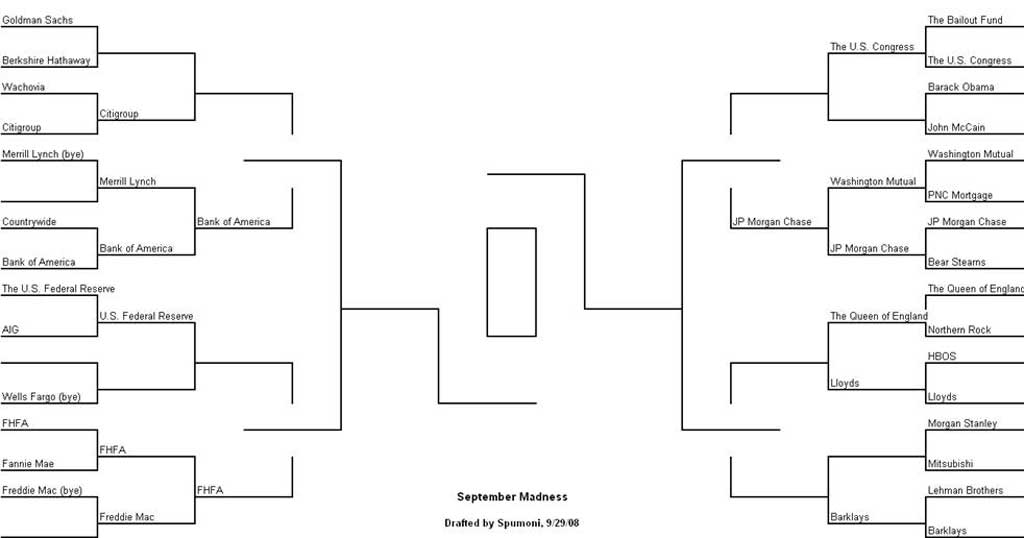
It's too early for March Madness, but here's a pool you can play if you're in the financial services industry - September Madness (click here for a larger version):

HT: Barry Ritholtx

HT: Barry Ritholtx
Friday, December 28, 2007
"Shocking" Economics Facts
I thought this short Youtube clip had some very interesting facts. They illustrate just how amazingly large our economy is relative to that of most countries. Let's just say that I'm glad to be living here.
Back to CFA studies.
Back to CFA studies.
Subscribe to:
Posts (Atom)