Monday, February 18, 2013

Risk Reward Ratio

Readers sometimes ask me why am I more in cash and less in the market.
My answer is that it always has to do with the "Risk Reward Ratio".
Take the current situation for e.g. When the media and ZH was screaming danger in last December (ZH is always screaming wolf anyway) I was telling readers to get bullish. We were long for the whole month of January and went to cash when SPX moved close to our price target of 1510. And for the last 3 weeks we have turned patient bear and yet not shorted the market. The reason we are not being long equities here can be explained in the following long term (monthly) SPX chart.


Assuming SPX keeps going up as everyone in Wall St and all talking heads in CNBC are saying, the upside in my view is limited to 1550 which is 2% up from here. It may take another 2 weeks and market does not correct, just to kill all the bears.
But on the other hand, should there be a correction (Not the end of the world, mind you) the long term support is a 1300 level, if 1400 does not hold. At 1400, that is 8% correction and at 1300, that is 15% correction.  So at best we have 8% / 2% = $ 4 risk and at worst 15% /2% = $7.5 risk. In other word, to go long here hoping to make $ 1, we will be risking $ 4 to $ 7.5. Is it worth it?
Just to break even on risk reward ratio, we need another 8% upside from here which is 1641 in SPX. I think that is bit far fetched. And although Ben has promised unlimited money, let us see what happens with the Sequestration thingy coming up in March.

Mind you, I am not suggesting that the world as we know it, is about to end. Simply because I do not know how economy works and what will be the unintended consequences. I just know how not to take unnecessary risk or at least I try not to.

 But I get the feeling that I am in that Jeep and the Volcano has already exploded and all the ash is bearing down. So better run or be in cash to take advantage of a better entry later.
Now you know why I am in Cash.

A real model of Minsky

Noah Smith has a wonderfully informative post on the business cycle in economics. He's looking at the question of whether standard macroeconomic theories view the episodic ups and downs of the economy as the consequence of a real cycle, something arising from positive feed backs that drive persisting oscillations all on their own, or if they instead view these fluctuations as the consequence of external shocks to the system. As he notes, the tendency in macroeconomics has very much been the latter:
When things like this [cycles] happen in nature - like the Earth going around the Sun, or a ball bouncing on a spring, or water undulating up and down - it comes from some sort of restorative force. With a restorative force, being up high is what makes you more likely to come back down, and being low is what makes you more likely to go back up. Just imagine a ball on a spring; when the spring is really stretched out, all the force is pulling the ball in the direction opposite to the stretch. This causes cycles.

It's natural to think of business cycles this way. We see a recession come on the heels of a boom - like the 2008 crash after the 2006-7 boom, or the 2001 crash after the late-90s boom - and we can easily conclude that booms cause busts.

So you might be surprised to learn that very, very few macroeconomists think this! And very, very few macroeconomic models actually have this property.

In modern macro models, business "cycles" are nothing like waves. A boom does not make a bust more likely, nor vice versa. Modern macro models assume that what looks like a "cycle" is actually something called a "trend-stationary stochastic process" (like an AR(1)). This is a system where random disturbances ("shocks") are temporary, because they decay over time. After a shock, the system reverts to the mean (i.e., to the "trend"). This is very different from harmonic motion - a boom need not be followed by a bust - but it can end up looking like waves when you graph it...
I think this is interesting and deserves some further discussion. Take an ordinary pendulum. Give such a system a kick and it will swing for a time but eventually the motion will damp away. For a while, high now does portend low in the near future, and vice versa. But this pendulum won't start start swinging this way on its own, nor will it persist in swinging over long periods of time unless repeatedly kicked by some external force.

This is in fact a system of just the kind Noah is describing. Such a pendulum (taken in the linear regime) is akin to the AR(1) autoregressive process entering into macroeconomic models and it acts essentially as a filter on the source of shocks. The response of the system to a stream of random shocks can have a harmonic component, which can make the output look roughly like cycles as Noah mentioned. For an analogy, think of a big brass bell. This is a pendulum in the abstract, as it has internal vibratory modes that, once excited, damp way over time. Hang this bell in a storm and, as it receives a barrage of shocks, you'll hear a ringing that tells you more about the bell than it does the storm.

Still, to get really interesting cycles you need to go beyond the ordinary pendulum. You need a system capable of creating oscillatory behavior all on its own. In dynamical systems theory, this means a system with a limit cycle in its dynamics, which settles down in the absence of persisting perturbation to a cyclic behavior rather than to a fixed point. The existence of such a limit cycle generally implies that the system will have an unstable fixed point -- a state that seems superficially like an equilibrium, but which in fact will always dissolve away into cyclic behavior over time. Mathematically, this is the kind of situation one ought to think about when considering the possibility that natural instabilities drive oscillations in economics. Perhaps the equilibrium of the market is simply unstable, and the highs and lows of the business cycle reflect some natural limit cycle?

Noah mentions the work of Steve Keen, who has developed models along such lines. As far as I understand, these are generally low-dimensional models with limit cycle behavior and I expect they may be very instructive. But Noah also makes a good point that the data on the business cycle really doesn't show a clear harmonic signal at any one specific frequency. The real world is messier. An alternative to low dimensional models written in terms of aggregate economic variables is to build agent based models (of much higher dimension) to explore how natural human behavior such as trend following might lead to instabilities at least qualitatively like those we see.

For some recent work along these lines, take a look at this paper by Blake LeBaron which attempts to flesh out Hyman Minsky's well known story of inherent market instability in an agent based model. Here's the basic idea, as LeBaron describes it:
Minksy conjectures that financial markets begin to build up bubbles as investors become increasingly overconfident about markets. They begin to take more aggressive positions, and can often start to increase their leverage as financial prices rise. Prices eventually reach levels which cannot be sustained either by correct, or any reasonable forecast of future income streams on assets. Markets reach a point of instability, and the over extended investors must now begin to sell, and are forced to quickly deleverage in a fire sale like situation. As prices fall market volatility increases, and investors further reduce risky positions. The story that Minsky tells seems compelling, but we have no agreed on approach for how to model this, or whether all the pieces of the story will actually fit together. The model presented in this paper tries to bridge this gap. 
The model is in crude terms like many I've described earlier on this blog. The agents are adaptive and try to learn the most profitable ways to behave. They are also heterogeneous in their behavior -- some rely more on perceived fundamentals to make their investment decisions, while others follow trends. The agents respond to what has recently happened in the market, and then the market reality emerges out of their collective behavior. That reality, in some of the runs LeBaron explores, shows natural, irregular cycles of bubbles and subsequent crashes of the sort Minsky envisioned. The figure below, for example, shows data for the stock price, weekly returns and trading volume as they fluctuate over a 10 year period of the model:


Now, it is not surprising at all that one can make a computational model to generate dynamics of this kind. But if you read the paper, LeBaron has tried hard to choose the various parameters to fit realistically with what is known about human learning dynamics and the behavior of different kinds of market players. The model also does a good job in reproducing many of the key statistical features of financial time series including long range fundamental deviations, volatility persistence, and fat tailed return distributions. So it generates Minsky-like fluctuations in what is arguably a plausible setting (although I'm sure experts will quibble with some details).

To my mind, one particularly interesting point to emerge from this model is the limited ability of fundamentalist investors to control the unstable behavior of speculators. One nice feature of agent based models is that it's possible to look inside and examine all manner of details. For example, during these bubble phases, which kind of investor controls most of the wealth? As LeBaron notes,
The large amount of wealth in the adaptive strategy relative to the fundamental is important. The fundamental traders will be a stabilizing force in a falling market. If there is not enough wealth in that strategy, then it will be unable to hold back sharp market declines. This is similar to a limits to arbitrage argument. In this market without borrowing the fundamental strategy will not have sufficient wealth to hold back a wave of self-reinforcing selling coming from the adaptive strategies.   
Another important point, which LeBaron mentions in the paragraph above, is that there's no leverage in this model. People can't borrow to amplify investments they feel especially confident of. Leverage of course plays a central role in the instability mechanism described by Minsky, but it doesn't seem to be absolutely necessary to get this kind of instability. It can come solely from the interaction of different agents following distinct strategies.

I certainly don't mean to imply that these kinds of agent based models are superior to the low-dimensional modelling of Steve Keen and others. I think these are both useful approaches, and they ought to be complementary. Here's LeBaron's summing up at the end of the paper:
The dynamics are dominated by somewhat irregular swings around fundamentals, that show up as long persistent changes in the price/dividend ratio. Prices tend to rise slowly, and then crash fast and dramatically with high volatility and high trading volume. During the slow steady price rise, agents using similar volatility forecast models begin to lower their assessment of market risk. This drives them to be more aggressive in the market, and sets up a crash. All of this is reminiscent of the Minksy market instability dynamic, and other more modern approaches to financial instability.

Instability in this market is driven by agents steadily moving to more extreme portfolio positions. Much, but not all, of this movement is driven by risk assessments made by the traders. Many of them continue to use models with relatively short horizons for judging market volatility. These beliefs appear to be evolutionarily stable in the market. When short term volatility falls they extend their positions into the risky asset, and this eventually destabilizes the market. Portfolio composition varying from all cash to all equity yields very different dynamics in terms of forced sales in a falling market. As one moves more into cash, a market fall generates natural rebalancing and stabilizing purchases of the risky asset in a falling market. This disappears as agents move more of their wealth into the risky asset. It would reverse if they began to leverage this position with borrowed money. Here, a market fall will generate the typical destabilizing fire sale behavior shown in many models, and part of the classic Minsky story. Leverage can be added to this market in the future, but for now it is important that leverage per se is not necessary for market instability, and it is part of a continuum of destabilizing dynamics.

Sunday, February 17, 2013

Upgrading My View On Tune insurance

A few days ago, I briefly blogged on Tune Insurance, the tagline being "Good but pricey". Over the past few days, I have had more opportunity to delve deeper into the company's prospects. Despite my initial guarded-ness, I think the listing could be a most exciting new listing for first half of 2013.


From a team of 16 people at the start of 2011 to acquiring a general insurance company with approximately 1,000 agents and 15 branches throughout Malaysia. It is getting to the stage where AirAsia having achieved economies of scale in terms of passengers, they can now be a force in anything that is remotely linked to this captive group of growing passengers. 

I mean if they could charge for seatbelt or going to toilet, that would be a listable concern on its own. As for insurance, its a captive crowd, those who do not sign up travel insurance should be labelled as "criminally stupid". Now think for a second, other forms of insurance requires a huge sales force, this is not only captive, growing, necessary and internet based... just a tick on the box. Money upfront.


Tune Insurance online insurance business comprises primarily of Travel Protection Plan and  other online insurance products such as the AA Lifestyle Protection Plan and the Tune Hotels Lifestyle Protection Plan. Their online insurance business is now underpinned by exclusive long-term agreements with AirAsia. In addition they have entered into a contractual arrangement with Tune Hotels. They operate in 14 markets across 12 countries.


Tune Insurance will spend more than half of its proceeds to repay loans, 22.5% on strategic investments, 12.24% for working capital and the rest to pay listing expenses. Upon completion of the IPO, the market capitalisation of Tune Ins is expected to reach RM1.17 billion based on the indicative retail offer price of RM1.55. Tune Ins is also targeting a minimum dividend payout ratio of 40% of the company's net profit.

The key to the above paragraph, if you read into it: by paying down loans, it improves the net margins substantially, mind you their margins are already very rich (around 50%); on strategic investments, its basically to acquire another one or two small insurance outfits in Indonesia, Thailand and maybe the Philippines.

I like AirAsia as a fundamental driven stock, I still think AirAsia should notch at least a 50% capital appreciation within 1.5 years. As much as I like AirAsia, I think Tune Insurance is a better stock: there is assured growth for at least the next 3-5 years, deeper penetration into bigger growth markets in Indonesia, Thailand and the Philippines. Margins wise, how to beat Tune Insurance - usually when a business makes that kind of margins, there will sprout numerous competitors to eat at your market share and eventually drive down margins. However, in this case, the market is captive, unless you want to drag yourself to a few more steps in buying travel insurance from other brokers.

Tune Insurance is a better business model than AirAsia: just look at the capital requirements, largely a web based outfit with just some offices to latch onto other forms of insurance which may be correlated to the travelers such as foreign workers insurance, health insurance, etc. It rides on AirAsia's growth but without the accompanying growth in wages, FUEL/OIL hikes, buying and maintenance of planes!!!???


The first column is "Passenger Movements Market CAGR growth". The second is AirAsia's current market share. The third is AirAsia's market share CAGR. (CAGR=cumulative average growth rate).


Malaysia         12.7%       44.2%      15.4%
Thailand         10.9%       14.8%      17.2%
Indonesia        18.2%       3.7%       20.3%
Figure 1: Passenger Activity growth rates at major airports, 2009-2011.
(Source: Prospectus)

As you can see, while AirAsia's market share is substantial in Malaysia, there is still a lot of room to capture more in Thailand and Indonesia. Judging from the track record, nobody in Asia, maybe even the world runs a better budget airline. You may not like Tony Fernandes as a person but you got to hand it to him, with or without favours. I believe Thailand and Indonesia will be huge hubs for AirAsia as the platform for AirAsia's business model will only work well provided there is ample workers and a relatively low wage base. Attempting to start a budget airline in a "medium to high wage cost" center is a recipe for disaster, or a candidate for AirAsia to come in and whack you.

Hence despite the rich valuations in terms of PER, I can see that they are listing Tune Insurance the moment they had the chance, and they could have waited till it got bigger. I may be mistaken in thinking there was substantial selling by promoters when in actual fact, its a relatively low figure. 

Currently 80% of revenue is from online whiles claims amounted to just 3%. If you compare that to normal motor vehicle insurance, the claims are closer to 70%.

Pssst... Tony, free advice for you, ...  you can further juice up Tune Insurance by going into "money transfers, wiring with outlets at all airports". This will cut out the inconvenience for a lot of travelers, esp foreign workers. Watch out Western Union.

I think Tune Insurance should be bought and held for 2-3 years at least, should hit RM2.80 by then with OK dividend yields to boot. For its listing this Wednesday, I think it will trade between RM1.50-RM1.72. This is the kind of stock that most long funds will want to buy and lock up, provided they get in at a decent price (which will in turn cap the downside) - got yield and capital appreciation plus growth and low risk, even though its business model is totally reliant on AirAsia.


p/s I do not know Tony, ... have not been given a bribe .... or free flights .... or promised to be entertained by AirAsia stewardesses.


NOTE: The above opinion is not an invitation to buy or sell. It serves as a blogging activity of my investing thoughts and ideas, this does not represent an investment advisory service as I charge no subscription or management fees (donations are welcomed though). The content on this site is provided as general information only and should not be taken as investment advice. All site content, shall not be construed as a recommendation to buy or sell any security or financial instrument. The ideas expressed are solely the opinions of the author. I may already have shares in the above mentioned stock/s. Any action that you take as a result of information, analysis, or commentary on this site is ultimately your responsibility. Consult your investment adviser before making any investment decisions.


Love These Smart Alecky Mocking Snippets

Movies are to be enjoyed but if you are funny, observant enough ... it can make for very funny mockumentary. I love dark or mean humour, to me funny is funny. Those who say low brow humour is the pits probably is too prim, proper, snobbish and stuck-up... and won't be welcomed in my playground.  Enjoy. 


Friday, February 15, 2013

US Equity Markets - Stars Are Aligned

It is imperative to look at the US markets when we are trying to predict global sentiment. More so now as a lot of the quantitative easing for the past 3 years have been sitting mainly by the sidelines, in money market funds and bonds. Somehow, there is a congruence of factors aligning together over the 2 months. First, you have the definitive sustained easing by Federal Reserve until unemployment reaches 6.5%, which won't be likely to be achieved for at least another 6 months. Secondly, you have Draghi somehow pulling a rabbit out of thin air to revive the Euro and that brought about an important demand for the weaker country bonds, which is so crucial in the continuing restructuring and repairing of the EU from the financial mess. Thirdly, you finally have a significant change in government in Abe for Japan, someone who is firmly for a sustained easing policy, targeting an inflation rate of 2%. A new BOJ top gun will be appointed to ensure that target.

The 3 factors all helped to move funds into equity because its pointless to stay sidelined in a near zero interest rate environment. Funds seeking safe havens in the yen and other selected currencies such as Swiss franc have finally turned the other way as they do not see a need for that anymore. Now you have the carry trade going into high gear again - previously the carry trade was in yen based on the near zero interest rate, now the carry trade is also in yen but on the platform that you will be probably be paying back in a weaker yen 6 to 12 month down the road.

US Funds Flow Into Equity

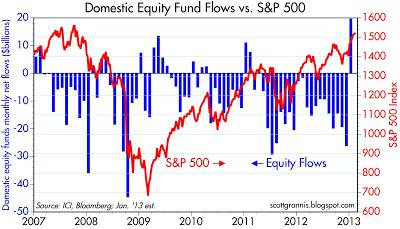
Domestic equity funds experienced their largest monthly inflow in the past six years, according to preliminary figures tallied by the Investment Company Institute (see first chart). This follows six years during which equity funds experienced huge and almost relentless outflows.
Has the tide finally turned? Are investors now finally becoming bullish after four years of strong equity gains? Perhaps, but if this is the beginning of the return of bullish sentiment, it likely has a long way to go before it runs out of gas.


VIX which measures market risk is in a very stable low risk zone.


Commercial Property Recovery

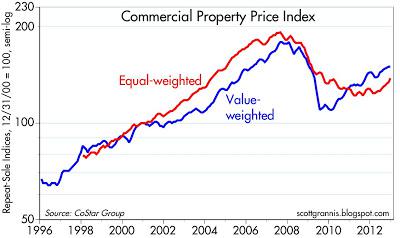
The recovery in commercial real estate is now almost four years old. As the first chart shows, commercial property prices are up decisively in recent years. As reported by Costar, its Value Weighted Index was the first to turn up due to strength in the high-end sector of property market. But now the equal weighted index is starting to catch up, a sign that the recovery is broadening.
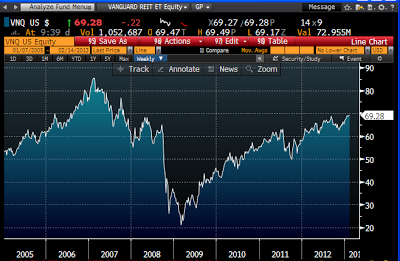
The second chart shows the price action for Vanguard's REIT fund, whose price has risen 215% from its March 2009 low. On a total return basis, this fund has trounced the S&P 500, gaining 287% vs. 142% since the March 2009 lows.
Thanks to panic-induced selling in late 2008 and early 2009, commercial real estate and related prices reached incredibly depressed lows. This represented one of the buying opportunities of a lifetime. If the economy merely avoids another recession, commercial real estate is likely to continue to deliver attractive returns relative to the almost-zero yield on cash.


Thursday, February 14, 2013

Teflon Market, Patient Bear.

Or its Deja Vu'

Its 2012 all over again. In the morning, the futures were down and markets opened lower but by mid-day BTFD crowd came in and helped push SPX in tiny green. Most likely tomorrow will be tiny red. Historically, Feb OpEx, which is tomorrow is green. So we will see who wins, red or green. But it does not change anything. And while we are on the sideline, some will short the market out of sheer boredom, only to have emotional trauma and lose money. Some will go long thinking this is the beginning of new bull run and shares will never correct because Ben will have their back. They will also lose big time. Its all about timing.
Timing says, do not front run, shut out the noise and the Zen moment will come. 


I know subscribers are getting impatient for lack of action, but we start with the premise that 1st goal is not to lose money. Rest will follow.

So folks, no new nugget of wisdom or fancy charts to share. Just chill till the appropriate signal comes.

Wednesday, February 13, 2013

Markets & Election Results

Will the Share Market Rise or Fall if there is a Pakatan Victory?

by Koon Yew Yin

Quote from an angry Internet reader
If [the] market plunge(s), it will rise up again but if a country goes bankrupt, it is gone forever. I don't know why you can't get it in your brain unless your brain is always thinking of sex with your mistress.

During the last few weeks there have been increasing predictions from Barisan leaders emphasising that there will be a sharp fall in the share market should there be a Pakatan Rakyat victory.

The latest prediction by MCA leader Chua Soi Lek in a party event at Kepong argues that Malaysia will witness a “‘huge financial disaster if Pakatan Rakyat comes to power in the 13th general election”.

This type of electioneering tactic aimed at frightening the electorate is dangerous and irresponsible. How can the MCA president be so confident as to openly declare that our stock market will drop to 500 points within a week if the opposition wins power?


Challenge to Dr. Chua Soi Lek
Let us subject his prediction to closer analysis. Firstly, it is not clear whether he stated that the KLCI will drop by 500 points or drop to 500 points.  Whichever is the correct version, his claim implies that anything from one to two thirds of the total share value of the KLCI will be wiped out due to the election result.

Now if this were to happen, the drop will be unprecedented in the history of share markets anywhere in the world. So far as I am aware, no modern national stock exchange has had such a sharp fall as a result of a national election outcome and I am sure it will not happen in Malaysia.

I am willing to place a big bet with Dr. Chua that his fears of a 500 point are unfounded and baseless.  The loser of the bet will have to donate an agreed sum of money to the other person’s preferred charity.   I hope he will agree to this and prove to be a man of his word.

Will the market rise on a BN victory
Not only should we discount the possibility of a sharp fall, but we should also – on the basis of stock market behavior elsewhere in the world – not assume that the Malaysian share market will automatically rise as the result of a Barisan victory. For example, on November 7th, immediately after Obama, the incumbent Democrat president was returned to power, the Dow Jones industrial average plummeted as much as 369 points, or 2.8 per cent, in the first two hours of trading. It recovered in the afternoon, but ended down 313, its biggest point drop for more than a year.

Various analysts that I have talked with have made the point that Chua Soi Lek is not a stock market expert. They argue that in trying to exaggerate the prospect of a market meltdown, Dr. Chua is contradicting the Barisan’s argument that the economy is fundamentally sound and resilient.  

At the same time, these analysts anticipate that there could be a market fall in the KLCI even if the Barisan is returned to power. They base this prediction on several factors:

1.       the BN through its control of EPF and other major government and government-linked investors has been supporting the market and propping up UMNO-linked counters such as Felda Global Ventures Holdings Bhd (FGV) which is struggling to hold on to its initial public offer price of RM4.55.  Without this pre-election support aimed at placating the Felda settlers and gaining their vote, FGV will definitely be trading below the IPO price.

2.       The European and American economies are still going through a phase of recovery. Although there has been an inflow of foreign funds into the Malaysian market, there could just as quickly be a reversal of financial flows.

Prediction of market rise with Pakatan victory  
What is likely to happen should there be a Pakatan victory? My prediction is that there will be a rise in the share market should there be no attempt at violence or a coup d’etatby the losers.  This is because of the following factors:


1.       The Malaysian economy has been under-performing all these years while under BN rule. We already should be familiar with the growth of GDP per capita of South Korea, Taiwan, Singapore and Malaysia. Since 1980 to 2011 we have been under performing every single one of those countries cited where once we we ahead of them.  Should we continue under BN rule, our economy is likely to continue to under-perform and our stock market will continue to stagnate not only in the short term after the elections but for the long term.

2. Foreign investors who have long been underweight in the Malaysian market due to Mahathir’s Disastrous Economic Model built around mega projects, crony capitalists as key players, and other distortionary policies will be attracted back into the market. As recently as in 2011, Bank of America Merrill Lynch noted that Malaysia remained a “big underweight” for investors in emerging markets. An underweight call is a recommendation for investors to reduce their investments in a particular security, asset class or, in this case, country. Malaysia also slipped from 14th place to dead last among the 15 countries studied by the investment bank, despite the roll out of big ticket Economic Transformation Programme projects.
There are other indicators that the market will not take fright but will rally on account of a Pakatan victory. As pointed out by an SME investor, they include:

1.       The fact that the opposition states of Penang, Selangor, Kedah and Kelantan have attracted more investment that the ten BN states by accounting for RM25 billion in investments comprising 53 per cent of Malaysia’s total investments of RM47.2 billion in 2010.

2.       If a major sell-down occurs in the Bursa as a result of a Pakatan victory, the nation’s economic institutions such as EPF, PNB, Khazanah and other GLCs would support the market.

3.       PAS has administered Kelantan for more than 20 years, and Kedah for five years. These two PAS state administrations have neither acquired nor appropriated property, assets or businesses belonging to non-Muslims.

Proposals for a sustainable market rise
Although I am optimistic that the market will rise on account of a Pakatan victory, it is necessary for the new government to act decisively when it comes to power.  I would like to propose the following measures to ensure that the post-elections market rise is sustainable:

1.       To form a business council with captains of the leading industries to find ways for economic improvement and expansion

2.       MACC directly under Parliament to look at illicit money outflows and recovery of the monies

3.       Investigate the way Petronas sells our national oil and to verify the rumour that it has a long term contract with a company which buys it at much lower than current prices.