
Thursday, June 21, 2012
Wednesday, June 20, 2012
Reality Comes Back.

It’s nice to see a plan working out. It’s nice to have your stand vindicated. And now I can say with more conviction that we are going to follow the script of 2010 and 2011. More than anything else I did not suffer from any anxiety attack and chew my nails off thinking what Bernanke will do.
Precious metal sector and Bonds were giving signal for quite a while that QE is not yet on the menu. Does this mean there will be no more QE? You must be kidding to even think like that! Of course there will be QE and it will be on August 1st. It is like joining the dots and draw a figure. It is that simple once you understand the principles at work.
Let us keep our focus in various time frames. Longer term we are screwed. The challenge then will be how best to preserve the capital. More than anything I am worried about possible social unrest that all the unemployed, hungry and armed have-nots will unleash. They have nothing to lose. It has already arrived at so called developed nations like Greece or Spain.
Even intermediate term, it is not that difficult to predict that stocks will go up one more time. Question is when the intermediate term begins. Let us apply our collective commonsense again. If QE is due on August 1st, then the intermediate term begins at August 1st and ends with the US Presidential election. So now we have narrowed ourselves in the short term, which is between now and July 30th. Question is, do we care? As an investor, I would not but as a trader I would like to take advantage of the coming volatility. We do not care that the system is rigged. Only thing we care about is bring on the right side of the rigged market.
Coming back to short term, I expect to see some corrections for the next few days. I do not think it will be huge and by the 1stweek of July, we will possibly reach around 1365 in SPX. Give or take few points of course. That would be a good place to take a relatively risk free trade. But we are still another 10-12 days away and a lot may change in between. You may ask, if there is no QE why should the equities go up at all in the 1st place? That is because of the 2nd quarter ending book adjustments and beginning of the month 401K allocation from the pension funds. There is another fancy name for manipulation, it is called window dressing!
So now all distractions are out of the way and not much rumour to play around with. We just wait for the last bit of window dressing be done with. Till then we patiently wait and see all the useless gyration of the respectable manipulators and applaud them for saving the world. Before I sign off, here is a trivia. Send me the answer if you can. Which is the most respected and loved drug dealing family of the world. A hint, the family has retired from opium trade for over 60 years now.
Thanks for reading http://bbfinance.blogspot.com/ . Please forward / re-tweet / post it on your wall and join me in twitter. (Twitter @ BBFinanceblog)(Stocktwits: Worldoffinance)

Tuesday, June 19, 2012
This Will Be A Great Concert
When Liu Chia Chiang meets Li Zhong Shen. I was not brought up on Mandarin popular music, if anything, I am more a Canto-pop kind of guy. However, if you examine the musical landscape of Mandarin music, no greater giants can you find other than the two names mentioned, from the 70s right up to the 90s. Naturally I prefer Li Zhong Shen, his lyrics already kills me most of the time and the melodies are superb as well.
Leslie Loh the producer has this to say when I asked him to elaborate why this concert is unmissable:
1) this is winnie ho's latest concert, and her only major concert in 2012, fresh from her sensational solo album! like her or not, you can't deny she can sing and very well at that!
2) it has two fantastic guest male singers in ah worm and ah fei
3) it has tay cher siang yet again. who doesn't know TAY CHER SIANG by now?
4) we are singing songs from the two most respected and legendary composers in the chinese pop history: jonathan lee and liu jia chang. together these two godfathers are responsible for evergreen classics too many to count!
5) winnie ho and tay cher siang are malaysia's treasures and they will carry the malaysian flag proudly abroad in the very near future. be the early supporters rather than late supporters cos it is cooler that way!
6) be part of the FIRST CHINESE JAZZ MOVEMENT in malaysia!
7) it is held in bentley music auditorium again, the 2nd best hall in malaysia after DFP in terms of acoustics
8) ticket price are only RM125 and RM85, well worth the price for a full-scale jazz production
9) you get to meet hundred of like-minded chinese jazz lovers under one roof! and lastly,
10) the organizer is pop pop music, you can't expect anything less from us (ahem, blowing a big trumpet!)

Indulge me while I share this song Ling Wu, so heartbreaking, to know and understand, to realise after just how great and wonderful they were together. Both LZS and Sandy Lam were married to each before, I cannot help but feel they were singing about each other. Beautifully aching, to say the least, ... who showed more regret and emotion?

The other LZS song that mesmerises me, the melody and lyrics ... OMG...
Leslie Loh the producer has this to say when I asked him to elaborate why this concert is unmissable:
1) this is winnie ho's latest concert, and her only major concert in 2012, fresh from her sensational solo album! like her or not, you can't deny she can sing and very well at that!
2) it has two fantastic guest male singers in ah worm and ah fei
3) it has tay cher siang yet again. who doesn't know TAY CHER SIANG by now?
4) we are singing songs from the two most respected and legendary composers in the chinese pop history: jonathan lee and liu jia chang. together these two godfathers are responsible for evergreen classics too many to count!
5) winnie ho and tay cher siang are malaysia's treasures and they will carry the malaysian flag proudly abroad in the very near future. be the early supporters rather than late supporters cos it is cooler that way!
6) be part of the FIRST CHINESE JAZZ MOVEMENT in malaysia!
7) it is held in bentley music auditorium again, the 2nd best hall in malaysia after DFP in terms of acoustics
8) ticket price are only RM125 and RM85, well worth the price for a full-scale jazz production
9) you get to meet hundred of like-minded chinese jazz lovers under one roof! and lastly,
10) the organizer is pop pop music, you can't expect anything less from us (ahem, blowing a big trumpet!)
buy your tickets at Popular CD-RAMA at ikano power center (IPC) or telephone booking at 012-2083790
Indulge me while I share this song Ling Wu, so heartbreaking, to know and understand, to realise after just how great and wonderful they were together. Both LZS and Sandy Lam were married to each before, I cannot help but feel they were singing about each other. Beautifully aching, to say the least, ... who showed more regret and emotion?

The other LZS song that mesmerises me, the melody and lyrics ... OMG...
Patience, Dear Mr. Watson.

SPX did remain elevated on Wednesday, i.e. today and I think it is all due to the QE expectation. Stock Traders Almanac has this to say: One of the driving forces of this speculation was a report from Goldman Sachs. Jan Hatzius, Goldman’s Chief U.S. Economist said that they “would be quite surprised if we saw no easing this week.” This was enough to stampede the bull all day.
Disappointment is going to be huge if dear Uncle does not come up with something substantial. At today’s level, Ben cannot justify further liquidity pumping. I think SPX have to drop substantially, may be 1200-1250 level for the Fed to act. Even Greece did not go out of Euro zone. So where is the crisis? As of today SPX reached and exceeded 1360 level. I was talking about this level when SPX broke 1284, not in very distant past. Only about 15 trading days back. But it took SPX much longer to reach here than I anticipated. I went out of the long position around 1340 level and after that SPX has moved in a range for about six trading days before breaking up. I am tempted to take up a short position tomorrow morning if the market opens higher but I have promised myself to stay away from any temptation. I think a better opportunity to short will come soon.
If Equities are going up expecting new QE, that enthusiasm has not been shared by the precious metal sector. Gold is having difficulties passing $ 1630 level. I may get out of the GLD position by the 1stweek of July, depending of course on the price action. If GLD remains at this level without breaking higher, it may be prudent to get out and re-enter at a lower level.
VIX was in red outside BB for most part of the day but closed in green. It has not yet triggered a sell signal and will do so when it closes inside BB. But I think in short term, VIX may fall further, to the level of 16.50 or so before it goes up again.
G20 achieved nothing except BRIC countries promised token donation to IMF. There was serious infighting and Canada lectured Europeans which they did not like. And Germany is not going to buy bonds of PIIGS either. Greece may discuss re-negotiation conditions as much as they like, but that is all wishful thinking.
So everything else now depends on the bearded mad scientist tomorrow. Alas he does not have the necessary cataclysm yet.
Let me finish by quoting Mr. David Weidner, legendary writer on Wall St. :
You can’t time the market: Also, technical analysis is phooey. Momentum plays are foolish. Anyone who wants to sell you a plan to beat the market is full of baloney. Investing schemes are exactly that. As I’ve written before, some people will tell you that you can hedge your bets. But insuring trades has never made sense to me. If you have to spend money to hedge a bet, it probably means you can’t afford to invest the money.
When it comes to markets, what can go wrong, will, and bubbles happen. The problem is we never know which is which until it’s too late.
Too often, we’re caught up in the daily fluctuations in our portfolios. What really matters is what the investments are worth when we need them.
Mutual funds are a waste of time: The fund industry was my first beat in New York. Here’s how it was explained to me: You buy a fund. The fund trails its index but you pay a management fee and other fees that are usually diminishing returns. You will pay a fee to buy the fund, or exit it, or both. Index and exchange-traded funds are the best thing to happen to investors since cash.
Hope you are keeping your powers dry. Patience is the key in such markets which are ruled by rumours and greed. Thanks for reading http://bbfinance.blogspot.com/ . Please forward / re-tweet / post it on your wall and join me in twitter. (Twitter @ BBFinanceblog)(Stocktwits: Worldoffinance)
Buffett's Most Realiable Indicator ... Not For Us
Buffett has said before that the total market cap vs. GNP is one of his preferred valuation metrics. The current reading of 89% is still above his preferred buying range (70-80%), but well off the highs we've seen in the last 15 years. Buffett has previously explained his thinking behind the indicator:
Yes, its a good indicator, but a very basic indicator akin to above or below NTA. If you are buying below 100%, you are "safer", its not rocket science. This indicator ranges from 60%-140% of GNP owing to the US economic structure.
One has to bear in mind that the market cap vs GNP relationship is very different for other countries.
One of my favoured economist, Chua Hak Bin, wrote on the same topic some time back, with an Asian flavour:
Malaysian Economy More Sensitive to Crashes
The Malaysian economy is however more sensitive to crashes. The representation of households who own shares directly or indirectly is probably similar to the U.S. profile. The market capitalisation of the KLSE is however about 320 percent of GNP. This implies that a 30 percent crash in the KLSE amounts to the equivalent wipe-out of 96 percent of GNP. If the stock of wealth is about 10 times GNP, this still amounts to a dissappearance of about 10 percent of total wealth. Such a sharp fall in wealth will inevitably hurt consumer spending.
The Malaysian economy's sensitivity to stockmarket crashes has been increasing over time with the rising market capitalisation of the KLSE. During the 1987 crash, Malaysia's stockmarket capitalisation accounted for only about 90 percent of GNP. As such, the ripple effects from the 1987 crash did not have such far reaching consequences. However, with the capitalisation accounting for more than 300 percent, Wall Street's sentiment may have become inevitably linked to the Malaysian economy. This worrisome conclusion extends to Hong Kong and Singapore whose market capitalisation have both exceeded 250 percent as well.
TABLE: THE MALAYSIAN ECONOMY IS OVEREXPOSED TO A STOCKMARKET CRASH
Some Comforting Thoughts
There are some important factors to account for when linking market capitalisation to total wealth. First, the rather high market capitalisation of the Kuala Lumpur, Singapore and Hong Kong stockmarkets are partly a result of its openness to foreign investors. As such, a large fraction of the market capitalisation is "foreign wealth" rather than "domestic wealth." The fraction will be higher in Singapore and Hong Kong than Malaysia. If the fraction of Malaysian shares which are foreign-held account for as much as 30 percent, then the true "domestic market-capitalisation to GNP" that matters for calculating the local "wealth effect" is reduced to only 224 percent.
Second, consumption is dependent on permanent rather than current wealth. Consumers take into account their future income when deciding on their habits today. If the fall in the stockmarket is regarded as temporary rather than permanent, consumers will not treat the loss as a real loss but a temporary paper loss. As a result, consumers will not reduce their spending as sharply when faced with the fall in current wealth. A word of caution is noted however as empirical studies have provided evidence that consumption is linked to current rather than permanent wealth due to the existence of credit constraints.
My Comments: It is not the Asian markets openness that causes the 300% market cap vs GNP, or anything to do with foreign investments. Rather, its the listing mentality of the respective countries coupled with the "designed rules". In Malaysia, once you start making RM3m-5m a year, there will be predators coming to you thinking of ways to list your company.
This makes for a much lower threshold to list companies in Asia (generally) than elsewhere. Hence you may generalise that the only things not listed in Malaysia are the mamaks and mechanics (though some of the bigger mamak chains make quite decent bucket loads of money, but then they have to worry about paying real taxes if they were to list them properly).
Of course we can still use the market cap vs GNP indicator for the Malaysian market alone, maybe the range over a 20 year period could be between 200% to 400%, and you surmise that anything below 300% might be a "safer" buying territory. To me, its still more b.s. than anything.
Hence we can also surmise that a market correction of 25% in the US and a similar 25% correction in Malaysian, Singaporean and HK markets are very different. The latter 3 countries will see a more pronounced real money flow effects (shrinkage and reduced velocity of money). In most of Europe the normal indicator is around 50%, which is to say a market correction has less real impact on the real economy as a large portion of the economy there are still not listed.
That indicator is shallow and does not relate or take into account the dynamics of the markets. For example, you can tally up the holdings of indexed stocks in Malaysia held by local funds, esp local government or GLC funds. Without the exact data, I can say it has been a substantial rise over the past 10 years, in particular over the last 5 years.
What that means may be that the index could be easier to "control". This will also mean that you may be able to "engineer better" a stock market sell down, or the reverse as well. Just think how well you could "control the index" if you hold 25% of all indexed stocks, what if its 35% or 45%, maybe 65% later on.
The amount of local funds have been mushrooming and EPF has really no space to put it anymore, which is why they have to think of overseas. The other local funds have also been growing as well. Its all good and well if it does not get to the level whereby there is more "manipulative streaks" than a genuine "investing strategy for better returns". The bigger danger is that if you hold a strong hand, you could also close a stock price "artificially higher every year end" to maintain the appearance of good performance for your overall funds, even though in reality the fundamental performance of the said stock may be not exciting.
The powers to be has to be fully aware of the potential distortion this may bring and prevent this scenario from ever occurring. We are not there yet, but we need to be on guard owing to rise in investible funds in our country.
"For me, the message of that chart is this: If the percentage relationship falls to the 70% or 80% area, buying stocks is likely to work very well for you. If the ratio approaches 200%-as it did in 1999 and a part of 2000- you are playing with fire."
So stocks aren't cheap, but they're also not terribly expensive based on this measure. If the recent trend holds we could be nearing Buffett's preferred buying range in the coming years….
(click to enlarge)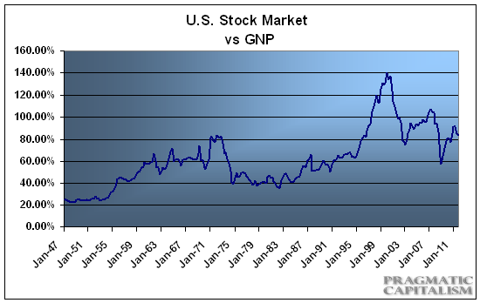
Yes, its a good indicator, but a very basic indicator akin to above or below NTA. If you are buying below 100%, you are "safer", its not rocket science. This indicator ranges from 60%-140% of GNP owing to the US economic structure.
One has to bear in mind that the market cap vs GNP relationship is very different for other countries.
One of my favoured economist, Chua Hak Bin, wrote on the same topic some time back, with an Asian flavour:
Malaysian Economy More Sensitive to Crashes
The Malaysian economy is however more sensitive to crashes. The representation of households who own shares directly or indirectly is probably similar to the U.S. profile. The market capitalisation of the KLSE is however about 320 percent of GNP. This implies that a 30 percent crash in the KLSE amounts to the equivalent wipe-out of 96 percent of GNP. If the stock of wealth is about 10 times GNP, this still amounts to a dissappearance of about 10 percent of total wealth. Such a sharp fall in wealth will inevitably hurt consumer spending.
The Malaysian economy's sensitivity to stockmarket crashes has been increasing over time with the rising market capitalisation of the KLSE. During the 1987 crash, Malaysia's stockmarket capitalisation accounted for only about 90 percent of GNP. As such, the ripple effects from the 1987 crash did not have such far reaching consequences. However, with the capitalisation accounting for more than 300 percent, Wall Street's sentiment may have become inevitably linked to the Malaysian economy. This worrisome conclusion extends to Hong Kong and Singapore whose market capitalisation have both exceeded 250 percent as well.
TABLE: THE MALAYSIAN ECONOMY IS OVEREXPOSED TO A STOCKMARKET CRASH
| Countries | Market Cap/ GNP (%) | Fall in Value from 30% Crash as Percent of GNP |
| Malaysia | 320 | 96 |
| Hong Kong | 290 | 87 |
| Singapore | 250 | 75 |
| Bangkok | 109 | 33 |
| London | 105 | 30 |
| New York | 70 | 21 |
| Bombay | 38 | 11 |
| Jakarta | 35 | 10 |
Some Comforting Thoughts
There are some important factors to account for when linking market capitalisation to total wealth. First, the rather high market capitalisation of the Kuala Lumpur, Singapore and Hong Kong stockmarkets are partly a result of its openness to foreign investors. As such, a large fraction of the market capitalisation is "foreign wealth" rather than "domestic wealth." The fraction will be higher in Singapore and Hong Kong than Malaysia. If the fraction of Malaysian shares which are foreign-held account for as much as 30 percent, then the true "domestic market-capitalisation to GNP" that matters for calculating the local "wealth effect" is reduced to only 224 percent.
Second, consumption is dependent on permanent rather than current wealth. Consumers take into account their future income when deciding on their habits today. If the fall in the stockmarket is regarded as temporary rather than permanent, consumers will not treat the loss as a real loss but a temporary paper loss. As a result, consumers will not reduce their spending as sharply when faced with the fall in current wealth. A word of caution is noted however as empirical studies have provided evidence that consumption is linked to current rather than permanent wealth due to the existence of credit constraints.
My Comments: It is not the Asian markets openness that causes the 300% market cap vs GNP, or anything to do with foreign investments. Rather, its the listing mentality of the respective countries coupled with the "designed rules". In Malaysia, once you start making RM3m-5m a year, there will be predators coming to you thinking of ways to list your company.
This makes for a much lower threshold to list companies in Asia (generally) than elsewhere. Hence you may generalise that the only things not listed in Malaysia are the mamaks and mechanics (though some of the bigger mamak chains make quite decent bucket loads of money, but then they have to worry about paying real taxes if they were to list them properly).
Of course we can still use the market cap vs GNP indicator for the Malaysian market alone, maybe the range over a 20 year period could be between 200% to 400%, and you surmise that anything below 300% might be a "safer" buying territory. To me, its still more b.s. than anything.
Hence we can also surmise that a market correction of 25% in the US and a similar 25% correction in Malaysian, Singaporean and HK markets are very different. The latter 3 countries will see a more pronounced real money flow effects (shrinkage and reduced velocity of money). In most of Europe the normal indicator is around 50%, which is to say a market correction has less real impact on the real economy as a large portion of the economy there are still not listed.
That indicator is shallow and does not relate or take into account the dynamics of the markets. For example, you can tally up the holdings of indexed stocks in Malaysia held by local funds, esp local government or GLC funds. Without the exact data, I can say it has been a substantial rise over the past 10 years, in particular over the last 5 years.
What that means may be that the index could be easier to "control". This will also mean that you may be able to "engineer better" a stock market sell down, or the reverse as well. Just think how well you could "control the index" if you hold 25% of all indexed stocks, what if its 35% or 45%, maybe 65% later on.
The amount of local funds have been mushrooming and EPF has really no space to put it anymore, which is why they have to think of overseas. The other local funds have also been growing as well. Its all good and well if it does not get to the level whereby there is more "manipulative streaks" than a genuine "investing strategy for better returns". The bigger danger is that if you hold a strong hand, you could also close a stock price "artificially higher every year end" to maintain the appearance of good performance for your overall funds, even though in reality the fundamental performance of the said stock may be not exciting.
The powers to be has to be fully aware of the potential distortion this may bring and prevent this scenario from ever occurring. We are not there yet, but we need to be on guard owing to rise in investible funds in our country.
Monday, June 18, 2012
The Great Game.

I quote from Mark Grant:
“It is the Great Game. They try to lure you into their various traps; I try to keep you out. They offer headlines from countless sources and I try to tell you what things really mean. They make use of a giant propaganda machine and I chant alone in the wilderness. They make up stories and present them as accurate data and I try to give you the facts. They want your money and I want you to “Preserve your Capital.” They are as diabolical in their pursuits as Professor Moriarty was in his. They are the political masterminds and I am a sort of Sherlock Holmes trying to analyze and conclude one case after the other. You may listen or you may not but I pay for my own supper while others ask for their compensation first. It is their Game, my Game; it is the Great Game”.
“Has all my instruction been for naught? You still read the official statement and believe it. It's a game, dear man, a shadowy game. We're playing cat and mouse; cloak and dagger.”
-Sherlock Holmes, A Game of Shadows
I could not have said it any better.
Bottom line, “ Cash”, at least till FOMC is over and we see the market reaction. I am very certain that the bearded one will not come up with candies for the market on June 20th but who knows. At least I am not taking any bet on the outcome and am content to sit it out.
Just like last Sunday, Euro spiked up and faded thereafter. But precious metal sector did not rally. Even when Equities held up for the day, credits was down and bonds were up. A correlation between SPX and Euro shows that the sync broke today.

Normally in such situations, either one catches up. Because of the market sentiment with Euro, I think in the very short term, there are less chances of Euro going up. Logically therefore, SPX will catch it downward but it may remain elevated till Wednesday. Question is how much down SPX will go from here? And therein lays the answer for week after. If SPX can hold 1300-1320 level this week, the next move would be higher. But that will be a bull trap, not a real up-move. More so if it comes without QE. If you are confused, just remember that we will have chop fest for the next two weeks but the selling is not over.
My take therefore is the same as last weekend. Nothing has been fixed. Market cannot go up without additional liquidity. Till that comes, the risk is to the downside in intermediate time frame although in short time frame, we may see higher highs. A heaven sent opportunity for the day traders but for a normal investor it is the worst kind of nightmare possible.
Thanks for reading http://bbfinance.blogspot.com/ . Please forward / re-tweet / post it on your wall and join me in twitter. (Twitter @ BBFinanceblog)(Stocktwits: Worldoffinance)
IHH, This One Is Fairer
Malaysia is the third-most-active venue for the IPOs globally this year after Felda's offering, up from 20th place at this time last year. IPOs on the Bursa Malaysia have raised $3.45 billion already, according to data provider Dealogic. A successful offering by IHH will only further strengthen Malaysia's standing in the global IPO market this year.

Despite the resounding 'success' of FGV, the book building among foreign institutions have been naturally disappointing. Many got less than 1% of what they actually bidded for. Both these big IPOs went for the cornerstone strategy, which requires pricing it well since they will be locking up for 6 months. Little for foreign institutions meant that market prices will move up as investors top up their holdings.
Bear in mind, the real market price is 6 months later when the lock up expires.
Elsewhere in the region, companies have been either delaying and cancelling their IPOs on worries about the euro-zone debt crisis and souring investment sentiment. In Singapore a $2.5 billion deal by motor-sport franchise Formula One Group was delayed earlier this month, while a $1 billion Hong Kong IPO by U.K.-based jeweler Graff Diamond Corp. was pulled.
Kuwait Investment Authority (KIA) will invest about US$150 million (RM477.8 million) in Malaysian firm IHH Healthcare’s planned US$2 billion (RM6.4 billion) IPO in Kuala Lumpur and Singapore. The investment is poised to make KIA the second-biggest investor in the Malaysian healthcare firm’s IPO. It will be the fund’s biggest investment in an Asian flotation since it poured US$800 million (RM2.5 billion) into Agricultural Bank of China’s US$21 billion (RM66.9 billion) offering in 2010.
With a heavy reliance on cornerstone investors and domestic demand, Malaysia has bucked the dismal IPO trend in other markets such as Singapore, where motor racing firm Formula One decided to delay its near US$3 billion (RM9.6 billion) offering due to volatile markets. In the latest blow to Asian deals, soccer club Manchester United also ditched its plans for an Asian stock market flotation and is preparing to list in the United States.

Cornerstone investors back many Asian listings, committing to buy large, guaranteed stakes and agreeing to a lock-up period during which they will not sell their shares.
KIA, which manages US$280 billion (RM891.4 billion) in assets, invests in big-ticket IPOs, but has been lately keeping its powder dry amid volatile markets. Malaysia pension fund EPF will separately invest about US$200 million (RM636.7 million) in the IHH IPO, making it the biggest investor in the deal, said the sources, who could not be named because the details of the deal are not public.
The IHH IPO is expected to be priced in the second week of July and the listing is scheduled in the week starting July 23, according to a term sheet. IHH this week already locked in BlackRock Inc, Capital Group and Och-Ziff Capital Management Group as cornerstone investors for its dual listing. The board of International Finance Corp (IFC), the financial arm of the World Bank, has also approved a proposal to become a cornerstone investor in IHH’s offering.

Finance Asia: Malaysia-based hospital operator IHH is looking to raise up to $2.2 billion but, excluding the cornerstones, only $280 million will be available for institutional investors.
Perhaps it is the fact that the company is operating in the healthcare industry that makes it so prudent, but IHH Healthcare, which is backed by state-owned Malaysian investment company Khazanah Internasional, is certainly taking no chances with its initial public offering.
In addition to the 15% of the offering that has already been set aside for Bumiputera, or ethnic Malay investors, the company has secured commitments from 22 cornerstone investors that will buy 57.7% of the deal.
In terms of the number of cornerstones, this may well be a record in Asia, but perhaps even more noteworthy is the quality of the accounts. The line-up comprises 12 international accounts, including three sovereign wealth funds and the International Finance Corp, as well as 10 Malaysian entities. A couple of the cornerstones were shareholders in Parkway and Pantai before these two units were taken private by IHH and delisted from the Bursa Malaysia and the Singapore Exchange in 2007 and 2010 respectively.
Another 14.6% has been earmarked for retail investors in Malaysia and Singapore, as well as directors and employees of the group, which means that only about 12.8% of the offering will be available to institutions through the bookbuilding that will kick off in early July.

Based on the earlier announced maximum price of M$2.85 per share and the announcement on Friday that IHH will sell up to 2.4 billion shares, including a 7.6% greenshoe, the deal could raise up to M$6.85 billion ($2.2 billion). But after taking away the other tranches, there will be only about $280 million worth of shares for international and non-Bumi Malaysian institutions combined. And that includes the greenshoe. Excluding the shoe, the institutional tranche will amount to only $124 million. Given the scarcity of shares, though, it is highly likely that the greenshoe will be exercised.
One could argue that the bookrunners may have gone a bit overboard by leaving so few shares for non-cornerstone institutions, but sources say the presence of so many high-profile cornerstones will help to validate the valuation, which involves quite a lot of assumptions about the growth in the next few years.
IHH currently has more than 4,900 beds divided on 30 hospitals as well as medical centres, clinics and other healthcare businesses across eight countries in Asia, the Middle East and Eastern Europe. Most of the beds are located in Malaysia, Singapore and Turkey — countries that the company refers to as its “home markets”. However, it will add a further 3,300 beds in the next five years, including the new Mt Elizabeth Novena hospital in Singapore, which is scheduled to open next month and will add about 333 beds by the end of 2013. The growth will come from new hospital developments as well as expansion of its existing facilities.

Importantly, the company has already paid about 75% of the capital expenditures for the new beds being added in the next five years, which means the ramp-up should have a significant impact on earnings.
Because of IHH’s many different businesses — apart from its core operations in Malaysia, Singapore and Turkey it also holds a 36% stake in Singapore-listed Parkway Real Estate Investment Trust (Reit) and an 11.2% stake in India-listed Apollo Hospital — and the lack of current earnings contributions from Mount Elizabeth Novena, analysts are using a discounted cash flow (DCF) and sum-of-parts-based methodology to value the company. DCF allows them to capture the strong cash-flow generation of the sector, as well as its defensive nature and structural growth prospects, but with the DCF assumptions being different for different countries, it does take some work to understand the valuation.
Syndicate analysts argue that the fair equity value for the company based on these calculations is about $8 billion to $10.5 billion, while the maximum price per share translates into an equity value of about $8.8 billion. The latter implies a 2013 enterprise value-to-Ebitda multiple of 16 times, which looks rich compare to other regional hospital operators like Singapore-listed Raffles Medical Group, Bangkok-listed Bangkok Dusit and India’s Apollo, which trade at about 13 to 14 times.
However, if you remove Mt Elizabeth Novena from the calculation, since it has yet to contribute any revenues, IHH’s EV/Ebitda multiple drops to about 11 times, according to a source. Analysts argue that IHH should trade at a premium to comps, however, due to its greater scale (versus other Asian operators) and stronger growth prospects (versus its US and Australian peers). Investors will have to get their heads around these numbers and in that context it should be helful that 22 cornerstones have already given their okay.
It is perhaps also lucky that the IPO process is so drawn out, as it will allow investors more time-than-usual to work on the numbers. The reason for the lengthy process is that the company is seeking to list in both Kuala Lumpur and Singapore, which means it will have to adhere to the rules related to prospectus exposures in both countries. Initially it will only offer shares to retail investors in Singapore, while the shares sold to institutional investors will all be listed in KL, but in terms of the timetable that makes no difference.

The company started investor education on June 8 and kicked off the management roadshow last Friday. However, the institutional order books will only be open from July 4 to 12. The pricing will follow shortly thereafter, while the trading debut is scheduled for July 28.
IHH is selling approximately 2.235 billion shares as part of the base offering, of which 1.8 billion are new. The remaining 434.7 million shares are secondary paper that will be sold by Abraaj Capital, the former owner of the Acibadem hospital in Turkey which got paid partly in shares when IHH acquired the business. Abraaj will sell its entire stake through the IPO.
In addition to that, there is a greenshoe of 169.4 million secondary shares that will be sold by Khazanah.
Including the shoe, the offering will account for 30% of IHH’s enlarged share capital. After the IPO, Khazanah will hold about 46%, while Japan’s Mitsui group will own 21% and the chairman of Acibadem Group about 3%.
The price range will be set just before the start of the bookbuilding, so the final proceeds have yet to be determined. But according to the preliminary prospectus, IHH will use 90.9% of the money raised to repay bank borrowings. A source said that this will reduce the company’s net debt-to-Ebitda ratio to about one time from five times based on 2012 numbers, which should put it in a good position to finance its future growth and to acquire additional assets.
One of the key buying arguments is scale. IHH will be the second-largest listed hospital operator in the world after HCA in the US and the largest in the high-growth emerging markets. It will be about twice the size of Bangkok Dusit, which is currently the largest hospital operator in Asia with a market cap of just under $450 million. The other companies in the sector are significantly smaller and, according to a source, the seven largest listed hospital operators in Asia have a combined daily turnover of only about $45 million.

The hospital sector is also quite defensive with visible earnings and predictable cash-flow generation. Healthcare spending is underpinned by rising GDP per capita, rising affluence and ageing population, and one syndicate research report noted that the growth of hospital beds has lagged the population growth in IHH’s home markets, which has resulted in a supply shortfall. This is helping to spur a migration to private-sector hospitals. Another growth driver is medical tourism, which is not only contributing to an increase in admissions, but is also pushing up margins.
The prospectus doesn’t provide a breakdown of how much each of the cornerstone investors are buying, except to note that Malaysia’s Employee Provident Fund Board is taking 200 million shares, or about 8.95% of the total offering (pre-shoe), and the Kuwait Investment Authority is buying 150 million shares, or 6.7% of the deal.
The other cornerstones are AIA Group, Blackrock Investment Management, Capital Group International, Capital Research Global Investors, CIMB-Principal Asset Management, CMY Capital Markets, Eastspring Investments, Fullerton Fund Management (a unit of Temasek), The Government of Singapore Investment Corp (GIC), HPL Investers and Como Holdings, Hwang Investment Management, International Finance Corp, JF Asset Management, Keck Seng (Malaysia) and Keck Seng (Hong Kong), Kencana Capital, Lembaga Tabung Haji, Mezzanine Equities, Newton Investment Management, Och-Ziff Capital Management Group, and Permodalan Nasional Berhad (BNP).
Bank of America Merrill Lynch, CIMB and Deutsche Bank are global coordinators and bookrunners. Credit Suisse, DBS, and Goldman Sachs are joint bookrunners.

Subscribe to:
Posts (Atom)